
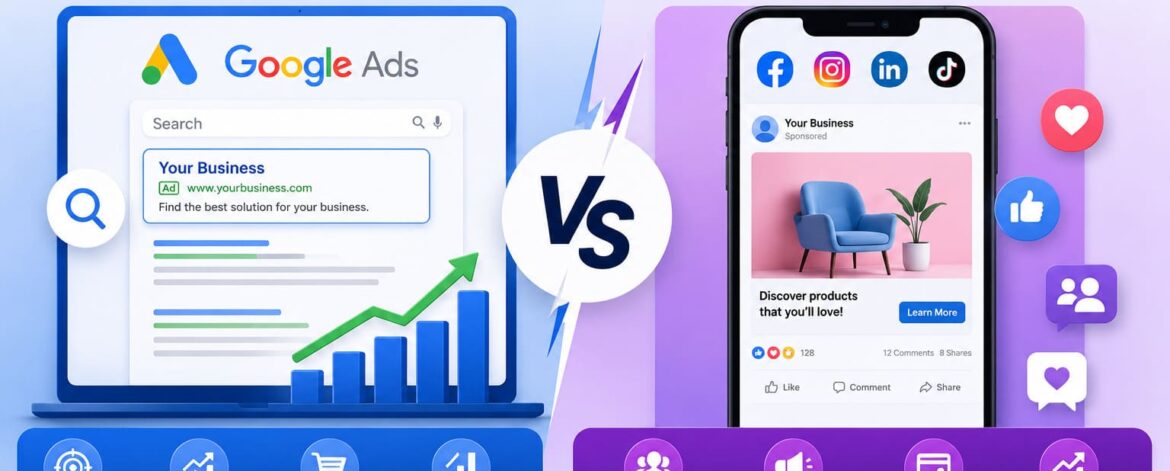
Digital advertising has become one of the most effective ways for businesses to reach potential customers, generate leads, and increase revenue. However, with so many advertising platforms available, choosing the right one can be challenging. Two of the most popular options are Google Ads and Social Media Ads.
While both advertising methods can deliver impressive results, they serve different purposes and target audiences in unique ways. Understanding their strengths and limitations can help you invest your marketing budget more effectively and achieve better returns.
In this guide, we’ll compare Google Ads and Social Media Ads to help you determine which platform is best suited for your business goals.
What Are Google Ads?
Google Ads is Google’s online advertising platform that allows businesses to display ads on Google Search, YouTube, Google Shopping, and millions of partner websites.
Google Ads primarily targets users based on their search intent. When someone searches for a specific product, service, or solution, your advertisement can appear at the top of the search results.
For example, if a user searches for “best digital marketing agency near me,” businesses running Google Ads can appear instantly in front of that potential customer.
Benefits of Google Ads
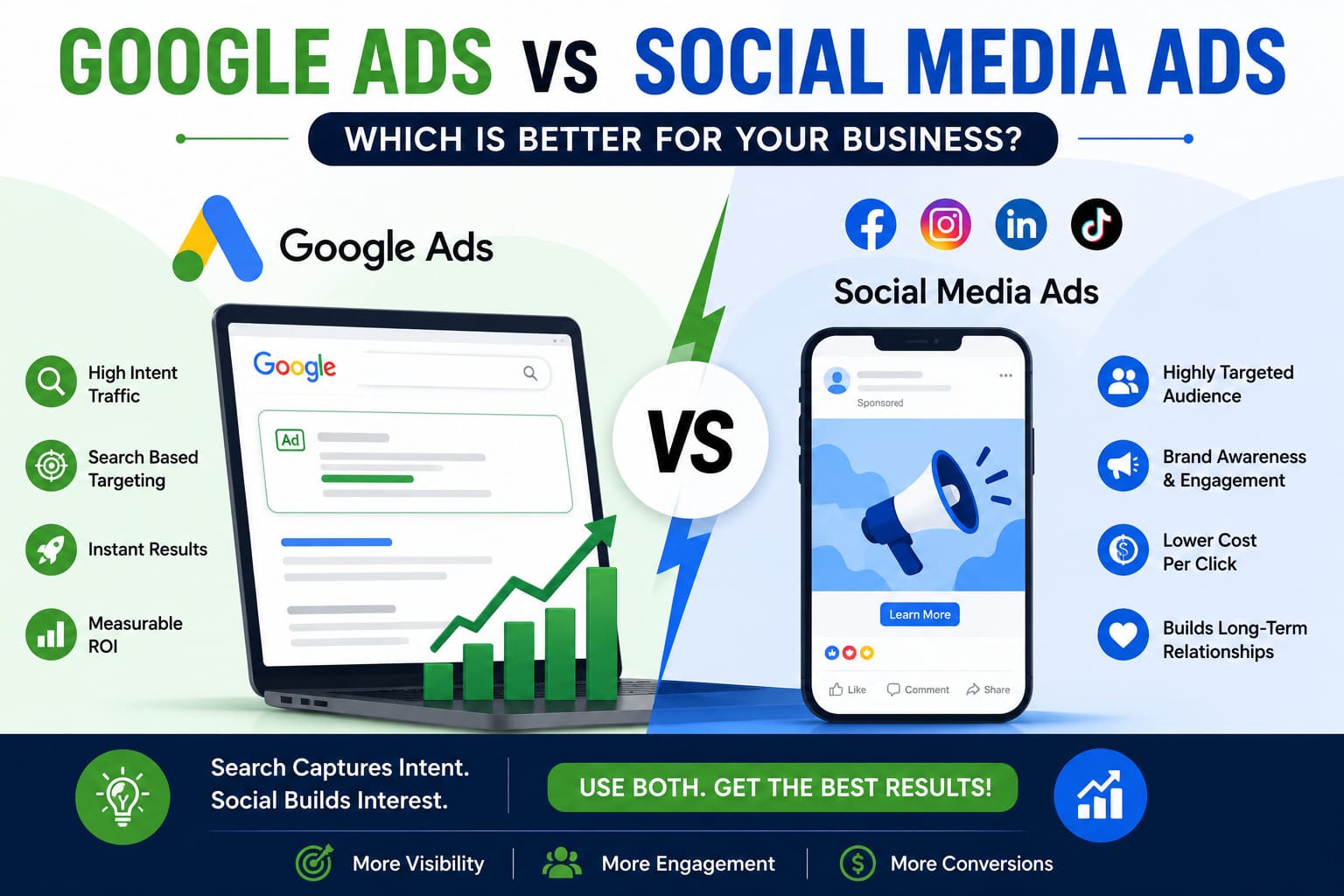
1. High Purchase Intent
Google users actively search for products and services, making them more likely to convert into customers.
2. Immediate Visibility
Unlike SEO, which can take months to produce results, Google Ads can place your business at the top of search results almost instantly.
3. Advanced Targeting
Businesses can target users based on keywords, location, device, demographics, and audience behavior.
4. Measurable Results
Google Ads provides detailed performance data, allowing advertisers to track clicks, conversions, and return on investment (ROI).
Challenges of Google Ads
Competitive industries often have high cost-per-click (CPC).
Campaign management requires ongoing optimization.
Results stop when advertising budgets are paused.
What Are Social Media Ads?
Social Media Ads are paid advertisements displayed on platforms such as Facebook, Instagram, LinkedIn, TikTok, Pinterest, and X (formerly Twitter).
Unlike Google Ads, Social Media Ads focus on audience targeting rather than search intent. Businesses can reach users based on interests, behaviors, demographics, job titles, hobbies, and online activities.
These platforms are highly effective for brand awareness, audience engagement, and relationship building.
Benefits of Social Media Ads
1. Precise Audience Targeting
Social platforms offer advanced targeting options that help businesses reach highly specific audiences.
2. Strong Brand Awareness
Visually engaging content helps businesses introduce their brand to potential customers who may not yet know about their products or services.
3. Lower Initial Advertising Costs
Many social media platforms offer affordable advertising options, making them suitable for small businesses and startups.
4. Visual Storytelling Opportunities
Businesses can use videos, images, carousels, and interactive content to capture attention and increase engagement.
Challenges of Social Media Ads
Users may not be actively looking for your products.
Conversion rates can be lower compared to search advertising.
Creative content requires frequent updates and testing.
Google Ads vs Social Media Ads: Key Differences
User Intent
Google Ads targets users actively searching for solutions, products, or services.
Social Media Ads target users based on interests and behaviors, even if they are not actively looking to make a purchase.
Lead Quality
Google Ads often generates higher-quality leads because users already have purchasing intent.
Social Media Ads excel at generating awareness and nurturing potential customers over time.
Cost
Advertising costs vary by industry and competition.
Google Ads may have higher CPCs, while Social Media Ads generally provide lower-cost impressions and broader audience reach.
Speed of Results
Both platforms can deliver quick results, but Google Ads often generates immediate leads because it captures existing demand.
Brand Building
Social Media Ads are generally more effective for storytelling, brand awareness, and customer engagement.
When Should You Choose Google Ads?
Google Ads may be the best choice if:
You want immediate leads or sales.
Customers actively search for your products or services.
You have a strong conversion-focused website.
You want measurable and direct ROI.
Examples include:
Law firms
Healthcare providers
Home services
SEO agencies
E-commerce stores
When Should You Choose Social Media Ads?
Social Media Ads may be ideal if:
You want to increase brand awareness.
Your products are visually appealing.
You are launching a new business or product.
You want to build a community around your brand.
Examples include:
Fashion brands
Restaurants
Fitness businesses
Personal brands
Lifestyle products
The Best Strategy: Use Both Together
For many businesses, the most effective approach is combining Google Ads and Social Media Ads.
Google Ads captures users who are actively searching and ready to buy, while Social Media Ads help build awareness and keep your brand visible throughout the customer journey.
A combined strategy allows businesses to:
Increase brand visibility
Generate qualified leads
Retarget website visitors
Improve conversion rates
Maximize overall marketing performance
Businesses that integrate both channels often achieve stronger long-term results than relying on a single advertising platform.
Conclusion
The debate between Google Ads and Social Media Ads doesn’t have a one-size-fits-all answer. The right choice depends on your business goals, target audience, budget, and marketing strategy.
If your primary goal is generating immediate leads and conversions, Google Ads may provide the fastest return. If you want to build brand awareness, engage audiences, and create long-term customer relationships, Social Media Ads can be highly effective.
For most businesses, combining both platforms creates a powerful digital marketing strategy that drives awareness, engagement, and conversions simultaneously.