
Search is changing quickly. People are no longer relying only on traditional Google search results to find information. They are also asking AI-powered platforms such as ChatGPT, Google AI Overviews, Gemini, and other generative search experiences for direct answers.
This shift has created a new area of digital marketing called Generative Engine Optimization (GEO).
GEO focuses on making your website content easier for AI systems and generative search engines to understand, identify, summarize, and potentially cite when answering user questions.
But GEO does not replace SEO or AEO. Instead, SEO, AEO, and GEO work together to create a stronger search visibility strategy.
What Is Generative Engine Optimization (GEO)?
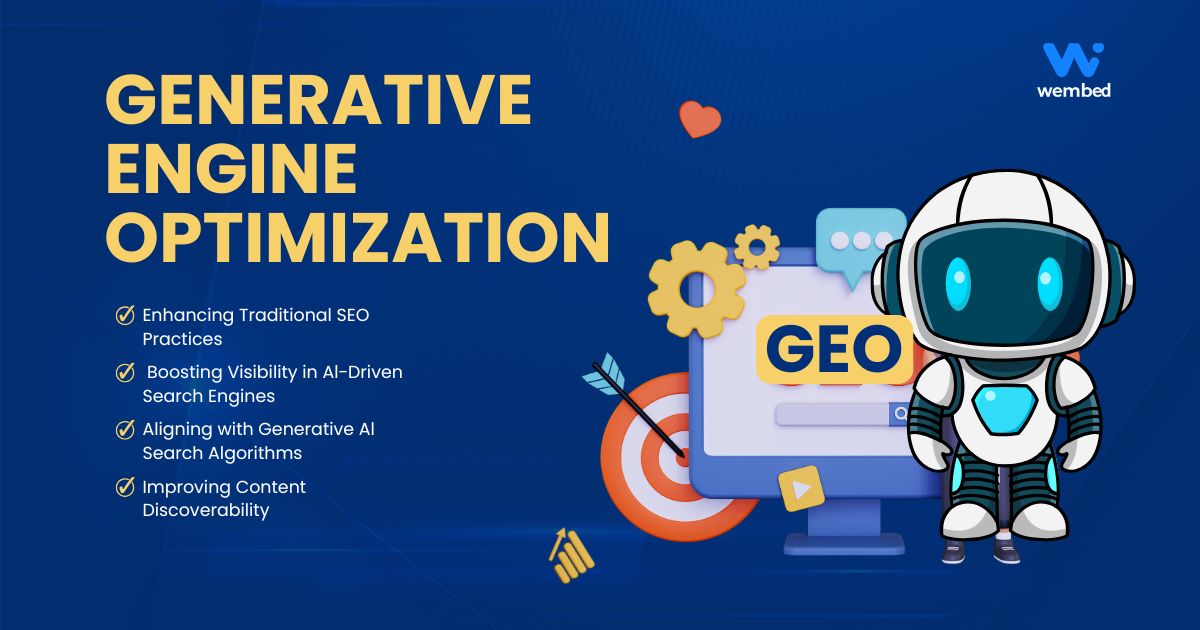
Generative Engine Optimization, or GEO, is the process of creating and optimizing online content so that it can be better understood and surfaced by AI-powered search and answer systems.
Traditional SEO focuses mainly on improving visibility in search engine results pages. AEO focuses on providing direct answers to user questions. GEO goes a step further by making information clear, useful, trustworthy, and easy for generative AI systems to interpret.
For example, instead of only targeting the keyword “digital marketing services,” a GEO-friendly page could directly answer questions such as:
What are digital marketing services?
Which digital marketing services does a small business need?
How much do digital marketing services cost?
How can digital marketing increase leads?
Which is better for a business: SEO, Google Ads, or social media marketing?
This question-and-answer approach helps users and gives search systems clearer information to understand.
Why Is GEO Important in 2026?
AI-powered search experiences are becoming an important part of how people discover information online. Google has also published guidance specifically about optimizing for generative AI features and explains that SEO fundamentals continue to matter for these experiences.
When users ask AI systems a question, they usually expect a useful answer rather than a long list of links.
This means businesses should think beyond traditional keyword rankings and consider:
How clearly their content answers questions
Whether their information is trustworthy
Whether their website demonstrates expertise
Whether their content provides original value
Whether search engines and AI systems can crawl and understand the page
Whether important information is structured clearly
GEO is therefore becoming an important part of a modern search strategy.
SEO vs AEO vs GEO: What Is the Difference?
| Strategy | Main Goal | Example |
|---|---|---|
| SEO | Improve visibility in search results | Rank for “SEO services” |
| AEO | Provide direct answers | Answer “What is SEO?” |
| GEO | Improve visibility in generative AI experiences | Help AI systems understand and reference your content |
The three strategies are connected.
SEO helps search engines discover and rank your content.
AEO makes your content easier to use as a direct answer.
GEO makes your content easier for generative systems to understand and potentially use in AI-generated responses.
A strong content strategy should combine all three rather than treating them as completely separate activities.
How Does Generative Engine Optimization Work?
GEO is not about inserting a special “GEO keyword” into an article.
Instead, it focuses on improving the overall quality, structure, clarity, credibility, and usefulness of your content.
A GEO-friendly page should make it easy for both humans and machines to understand:
Who created the content?
What question does it answer?
What evidence supports the information?
What makes the content different from competing pages?
Can the information be easily understood and extracted?
Google’s guidance emphasizes original, helpful, people-first content rather than content created primarily to manipulate rankings.
What Makes Content GEO-Friendly?
There is no guaranteed formula that makes a page appear in an AI-generated answer. However, you can improve the quality and accessibility of your content by following strong search and content practices.
Create Original and Useful Information
Avoid simply rewriting information that already exists online.
Add something valuable, such as:
Original examples
First-hand experience
Data
Case studies
Expert opinions
Comparisons
Practical steps
Unique insights
Real business examples
Google recommends creating content that provides substantial value instead of simply summarizing what other websites have already said.
Answer Questions Directly
AI search users often ask complete questions.
Instead of writing:
Generative Engine Optimization
Write sections such as:
What is Generative Engine Optimization?
Then answer the question directly in the first few sentences.
This creates a clear relationship between the question and answer.
Use Clear Content Structure
A well-organized page is easier for users to scan and easier for systems to understand.
Use:
A descriptive title
Clear headings
Short paragraphs
Bullet points
Tables where useful
Definitions
Examples
Step-by-step instructions
FAQs
Avoid unnecessarily complicated language.
Demonstrate E-E-A-T
Trust is especially important when creating useful online content.
Your content can demonstrate experience, expertise, authoritativeness, and trustworthiness through:
Author information
Expert review
First-hand experience
Reliable references
Original research
Accurate information
Transparent claims
Updated content
Google describes E-E-A-T as a useful framework for assessing the trustworthiness and quality of content, with trust being the most important aspect.
Support Important Claims
Don’t make unsupported claims such as:
“SEO will definitely double your traffic.”
Instead, explain the reasoning and provide evidence where appropriate.
Linking to reliable sources can also help readers verify important information.
Keep Information Fresh
Generative search experiences need useful and accurate information.
Review important pages regularly and update:
Statistics
Examples
Product information
Industry trends
Screenshots
Links
Outdated recommendations
However, don’t change dates simply to make old content appear fresh. Google specifically advises against this approach.
How to Optimize a Blog for SEO, AEO and GEO
A modern blog can target all three strategies using one content framework.
Step 1: Start With Search Intent
Before writing, understand what the user actually wants.
For example, someone searching:
“GEO optimization”
may want a definition.
Someone searching:
“how to optimize content for generative AI”
may want a step-by-step guide.
Someone searching:
“GEO vs SEO”
probably wants a comparison.
Match the content with the user’s intent instead of forcing keywords into the article.
Step 2: Build a Question-Based Keyword Map
Research your primary keyword and related questions.
For example:
Primary keyword: Generative Engine Optimization
Related keywords:
GEO optimization
GEO SEO
Generative Engine Optimization services
AI search optimization
AI SEO
GEO strategy
optimize content for AI search
SEO AEO GEO
generative search optimization
Question keywords:
What is GEO?
How does GEO work?
Why is GEO important?
How is GEO different from SEO?
How do I optimize content for AI search?
Does SEO still matter for AI search?
This creates a content structure that supports traditional and conversational search.
Step 3: Give Short Answers Before Detailed Explanations
For important questions, answer first and explain afterward.
For example:
What is GEO?
GEO is the practice of creating and structuring content so generative AI and AI-powered search systems can better understand and potentially surface the information in their answers.
Then provide the detailed explanation.
This format is useful for AEO and GEO while remaining easy for humans to read.
Step 4: Add Supporting Evidence
Use trustworthy sources, original research, examples, and data where relevant.
This is especially important for topics where users need reliable information.
Google recommends accuracy, quality, and relevance when using AI-assisted or AI-generated content.
Step 5: Strengthen Internal Linking
Connect related pages naturally.
For example, a GEO article could link to:
SEO services
Content marketing
Technical SEO
Web development
Google Ads
Social media marketing
Internal links help users discover related information and help search engines understand relationships between pages.
Step 6: Optimize Technical SEO
GEO should not be treated as a replacement for technical SEO.
Make sure your website is:
Crawlable
Indexable
Mobile-friendly
Fast
Secure
Easy to navigate
Properly structured
Free from important technical errors
Google states that websites need to meet technical requirements so their content can be found, crawled, indexed, and considered for search results, including AI search experiences.
Step 7: Use Structured Data Correctly
Structured data can help search systems understand specific information on a page.
However, don’t add schema simply because you want an AI system to show your content.
Your structured data should accurately represent information that is visible on the page and follow Google’s guidelines.
How to Create GEO-Friendly Blog Content
A practical GEO-friendly blog structure can look like this:
Title
Answer the main topic clearly.
Introduction
Explain the problem and what the reader will learn.
Direct Answer
Give a concise answer to the primary question.
Detailed Explanation
Explain the topic with examples and supporting information.
How-To Section
Provide actionable steps.
Comparison
Compare related concepts where useful.
Expert Insights
Add experience, examples, data, or original observations.
FAQs
Answer relevant conversational questions.
Conclusion
Summarize the key points.
CTA
Guide the reader toward the next relevant action.
This structure works well because it serves both readers and search systems without creating content solely for algorithms.
GEO Content Mistakes to Avoid
Keyword Stuffing
Repeating “Generative Engine Optimization” excessively does not make content more GEO-friendly.
Use natural language and related terminology.
Creating Mass AI Content
AI can help with research, outlines, editing, and content creation, but publishing large amounts of low-value AI-generated content can create quality problems.
Google states that using generative AI to create many pages without adding value may fall under its scaled content abuse policy.
Writing Only for AI
Your primary audience should still be people.
Don’t create strange sentences simply because you think an AI system will understand them better.
Clear human writing is usually the better approach.
Making Unsupported AI Ranking Claims
Be careful with claims such as:
“Use these 10 words and ChatGPT will rank your website.”
There is no guaranteed formula for appearing in AI-generated answers.
GEO should focus on improving the quality, usefulness, clarity, and accessibility of your content.
Ignoring Traditional SEO
GEO does not mean you should stop doing SEO.
Google’s current guidance explicitly explains that established SEO best practices remain relevant for generative AI search experiences.
GEO Content Checklist
Before publishing a GEO-friendly article, check the following:
Does the article answer the main search intent?
Is the primary question answered clearly?
Does the article provide original value?
Are important claims supported?
Are headings descriptive and useful?
Are paragraphs easy to read?
Are relevant questions answered?
Are internal links included naturally?
Is the page technically crawlable and indexable?
Is the content mobile-friendly?
Is structured data accurate where applicable?
Is the author or source information clear?
Has outdated information been reviewed?
Does the content demonstrate real expertise or experience?
Was AI used as a tool rather than simply publishing unedited output?
Frequently Asked Questions About GEO
What does GEO stand for in digital marketing?
GEO stands for Generative Engine Optimization. It refers to optimizing content and websites for visibility and understanding within generative AI and AI-powered search experiences.
Is GEO the same as SEO?
No. SEO focuses on improving search visibility, while GEO focuses on making content useful and understandable within generative search experiences. The two strategies overlap and should work together.
Is AEO part of GEO?
AEO and GEO are closely related but are not exactly the same. AEO focuses strongly on providing direct answers to questions, while GEO takes a broader approach to visibility within generative AI experiences.
Does SEO still matter with AI search?
Yes. Google’s current guidance says SEO best practices continue to be relevant for generative AI search experiences.
Can AI-generated content rank on Google?
Yes, AI-assisted or AI-generated content can appear in search, but using AI does not provide a special ranking advantage. Google emphasizes helpful, original, accurate, people-first content and warns against using automation primarily to manipulate rankings.
How can a business start with GEO?
Start by improving existing content. Identify important customer questions, create direct and useful answers, strengthen expertise and trust signals, add original information, improve internal linking, and ensure the website has a strong technical SEO foundation.
The Future of SEO, AEO and GEO
Search is becoming more conversational and more AI-driven, but the fundamental goal remains the same: help people find useful and trustworthy information.
Businesses should therefore avoid treating GEO as a shortcut or replacement for SEO.
The stronger approach is to combine:
SEO + AEO + GEO + Helpful Content + E-E-A-T + Technical SEO
Together, these strategies create a more complete search visibility framework.
The future of search is not simply about ranking one keyword. It is about becoming a reliable source of information that users, search engines, and AI-powered experiences can understand and trust.
Conclusion
Generative Engine Optimization is becoming an important part of modern digital marketing as users increasingly interact with AI-powered search experiences.
The best GEO strategy is not about trying to “hack” AI systems. It is about creating clear, original, accurate, useful, and trustworthy content that genuinely answers people’s questions.
By combining traditional SEO with AEO and GEO, businesses can build content that is easier for users to discover, understand, and act on across both traditional and generative search experiences.
If you’re ready to grow your business online, Wembed can help you every step of the way. From building high-performing websites with our Web Development Services, increasing qualified traffic through SEO Optimization Services, generating more leads with Google & Social Media Ads, to strengthening your brand with Social Media Marketing Services, our team delivers complete digital solutions tailored to your goals. Get your free website audit today and discover where you’re losing potential customers—and how to turn more visitors into paying clients.